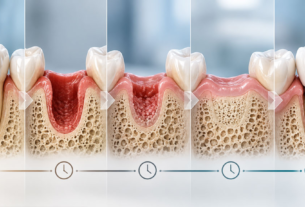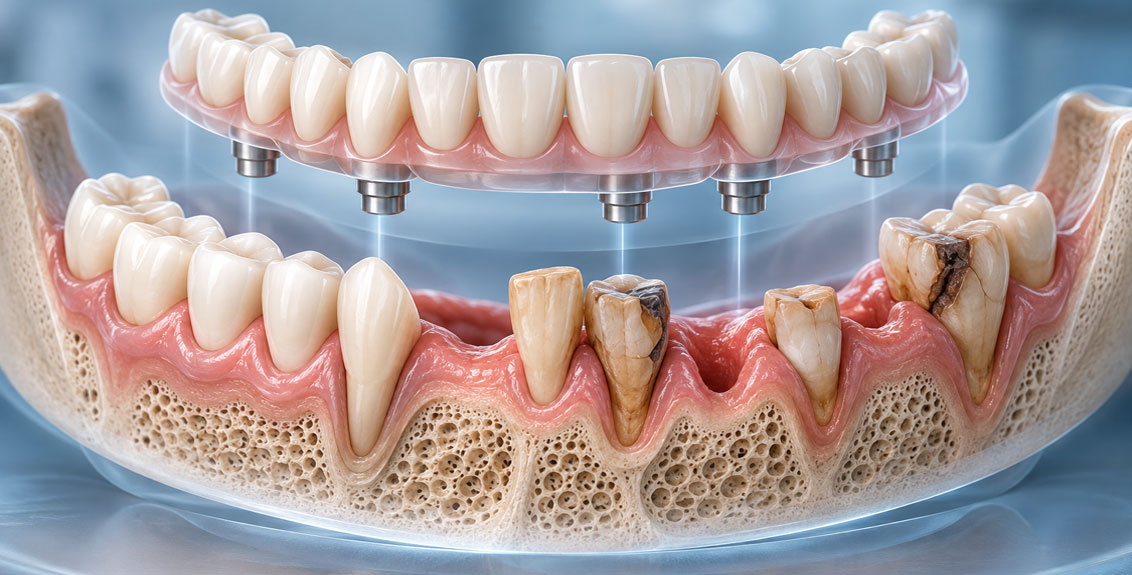
Having natural teeth remaining does not automatically mean that full-arch implant treatment is inappropriate—and considering full-arch implants does not automatically mean that every remaining tooth should be removed. The decision depends on the health and expected longevity of those teeth, their distribution across the jaw, the condition of the supporting tissues, and how they fit into a long-term plan for the entire dental arch. Current implant consensus recommendations specifically advise considering preservation of existing teeth when evaluating full-arch treatment options. [1]
Why Remaining Teeth Change the Treatment Plan
A dental arch is the curved row of teeth in either the upper or lower jaw. A full-arch fixed implant restoration is designed to replace all of the teeth in that arch with a prosthesis supported by dental implants.
That makes the condition of any remaining natural teeth an important part of the decision. Before planning a complete implant-supported arch, the clinician must determine whether those teeth have a reasonable future and whether preserving some or all of them could support a different treatment approach.
The International Team for Implantology (ITI) consensus recommendations state that when patients still have teeth, the available treatment options should be considered as part of informed consent, with appropriate consideration given to preserving natural teeth. [1]
The decision therefore begins with the teeth that remain—not with an assumption that they need to be extracted.
A Tooth That Functions Today May Still Have an Uncertain Future
A tooth can feel comfortable and function normally today while still having a questionable long-term outlook.
Dentists use the term prognosis to describe an informed estimate of how a tooth is likely to perform over time. Prognosis takes into account the condition of the tooth itself, the bone and gum supporting it, previous treatment and other clinical factors.
Research into periodontal prognosis illustrates why this assessment is not always straightforward. In one study, 100 treated periodontal patients were followed during maintenance for five years, with 38 followed for eight years. The researchers found that clinical characteristics could help predict changes in prognosis, but the accuracy of those predictions varied over time. [4]
In other words, prognosis is not a guarantee. It is a clinical judgment based on the available evidence and the individual circumstances of the patient.
What Determines Whether a Tooth Is Worth Preserving?
No single measurement determines whether a remaining tooth should be retained or extracted. Published decision frameworks recommend considering multiple factors together. [2]
These may include:
Periodontal support. This refers to the gum and bone structures that hold a tooth in place. Significant loss of supporting bone can reduce the tooth’s stability and long-term outlook.
Mobility. Excessive movement of a tooth may indicate weakened periodontal support, although mobility needs to be interpreted together with other findings.
Decay and structural damage. Extensive decay, major fractures or damage extending deep into the root can make predictable restoration difficult.
Previous treatment and infection. Large restorations, previous root-canal treatment and persistent infection may influence the tooth’s prognosis.
Restorability. Even if a tooth can technically be treated, the clinician must consider whether it can be restored to provide useful, maintainable function over the long term.
Overall periodontal condition. A tooth should not be evaluated completely independently of the health of the tissues throughout the mouth.
The result is not simply a classification of “good” or “bad.” Different teeth may have very different expected futures even within the same mouth.
Why the Whole Arch Matters
Full-arch planning requires more than counting how many teeth remain.
The clinician considers the condition and location of the remaining teeth together with the proposed final restoration, available bone, bite, aesthetic requirements, space for the prosthesis, oral-hygiene needs and other anatomical and functional factors. Full-arch implant consensus recommendations emphasize that the final prosthetic design should be considered when planning implant treatment. [1]
This means that two patients with the same number of remaining teeth could receive very different recommendations.
One may have several maintainable teeth that make a tooth-preserving restorative approach reasonable. Another may have a similar number of teeth, but widespread periodontal destruction, fractures, extensive decay or other problems that make long-term preservation much less predictable.
The quality and overall condition of the remaining dentition matter more than the number alone.
When Removing Remaining Teeth May Be Considered
There are circumstances in which removing compromised teeth becomes part of a comprehensive full-arch reconstruction.
For example, several remaining teeth may have severe loss of supporting bone, extensive structural damage, persistent disease or a combination of problems that gives them an unfavorable long-term prognosis. Maintaining such teeth may require repeated procedures without providing a predictable foundation for long-term rehabilitation.
If a clinical evaluation determines that the remaining dentition cannot reasonably be maintained, full-arch implant treatment may then become one of the available replacement strategies.
However, the important sequence is evaluation first, extraction decision second.
A full-arch implant plan should not itself be the reason that otherwise maintainable teeth are automatically classified for removal.
Why Extraction Deserves Careful Consideration
Extraction is irreversible.
A systematic review comparing long-term survival of treated teeth and implants found that implant survival did not exceed the survival of compromised teeth that had been appropriately treated and maintained. The authors therefore advised caution when deciding between extraction and implant placement. [3]
That finding does not mean compromised teeth should always be retained, nor does it mean implants should be avoided. The studies examined tooth and implant survival generally rather than the specific circumstances of every patient considering full-arch rehabilitation.
The more useful conclusion is that an implant should not automatically be regarded as superior to a natural tooth that can be predictably maintained.
This principle is also reflected in contemporary full-arch implant guidance, which recommends considering tooth preservation when teeth remain. [1]
What If Some Teeth Can Be Saved?
When enough maintainable natural teeth remain, alternatives to complete full-arch replacement may be possible.
Depending on the circumstances, treatment could involve restoring existing teeth, treating periodontal disease, replacing selected missing teeth with individual implants or implant-supported bridges, or using a removable partial prosthesis.
These alternatives are not necessarily better or worse than full-arch treatment. Their suitability depends on the condition and distribution of the remaining teeth, available bone, the bite, maintenance requirements, patient preferences and other clinical factors.
This is why full-arch treatment planning is fundamentally different from simply asking whether implants can be placed.
Looking at the Mouth as a Long-Term System
A thorough assessment typically combines clinical examination with appropriate dental imaging. The clinician evaluates periodontal health, bone support, decay, fractures, previous dental treatment, bite relationships and the restorability and prognosis of individual teeth.
Each remaining tooth can be assessed individually, but the final decision must also make sense for the arch as a whole.
For someone considering full-arch implants while still having natural teeth, one of the most useful questions to ask is therefore:
What is the long-term prognosis of the teeth I still have, and what treatment options would allow any maintainable teeth to be preserved?
Full-arch implant treatment can be an important option when an entire dentition can no longer be predictably maintained. But the presence of compromised teeth does not, by itself, mean that every remaining natural tooth should be removed.
This article provides general educational information and is not a substitute for individual diagnosis or treatment planning by a qualified dental professional.
References & Sources
[1] Morton D, Gallucci G, Lin WS, et al. Group 2 ITI Consensus Report: Prosthodontics and implant dentistry. Clinical Oral Implants Research. 2018;29(Suppl 16):215–223. DOI: 10.1111/clr.13298. The consensus includes recommendations concerning preservation of teeth and planning of complete-arch implant prostheses. Link
[2] Avila G, Galindo-Moreno P, Soehren S, Misch CE, Morelli T, Wang HL. A novel decision-making process for tooth retention or extraction. Journal of Periodontology. 2009;80(3):476–491. DOI: 10.1902/jop.2009.080454. PMID: 19254132. Link
[3] Levin L, Halperin-Sternfeld M. Tooth preservation or implant placement: a systematic review of long-term tooth and implant survival rates. Journal of the American Dental Association. 2013;144(10):1119–1133. DOI: 10.14219/jada.archive.2013.0030. PMID: 24080928. Link
[4] McGuire MK, Nunn ME. Prognosis versus actual outcome. II. The effectiveness of clinical parameters in developing an accurate prognosis. Journal of Periodontology. 1996;67(7):658–665. DOI: 10.1902/jop.1996.67.7.658. PMID: 8832476. Link
Important Keywords
full arch dental implants with remaining teeth, full arch dental implants, remaining teeth before dental implants, extracting teeth for full arch implants, failing teeth and dental implants, tooth preservation, tooth prognosis, periodontal support, full mouth dental implants
What do you feel about this post?

Like

Love

Happy

Haha

Sad