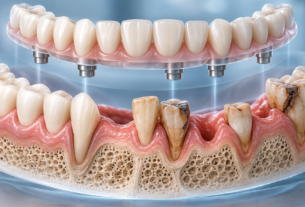
A dental implant after tooth extraction can sometimes be placed on the same day the tooth is removed, while in other situations waiting several weeks or months provides a more suitable foundation for treatment. The appropriate timing depends less on a fixed calendar and more on the condition of the extraction site—particularly the available bone, health of the surrounding gum tissue, presence of acute infection, and whether the implant can be positioned securely. There is therefore no single waiting period that is appropriate for every patient. [1]
What Happens After a Tooth Is Extracted?
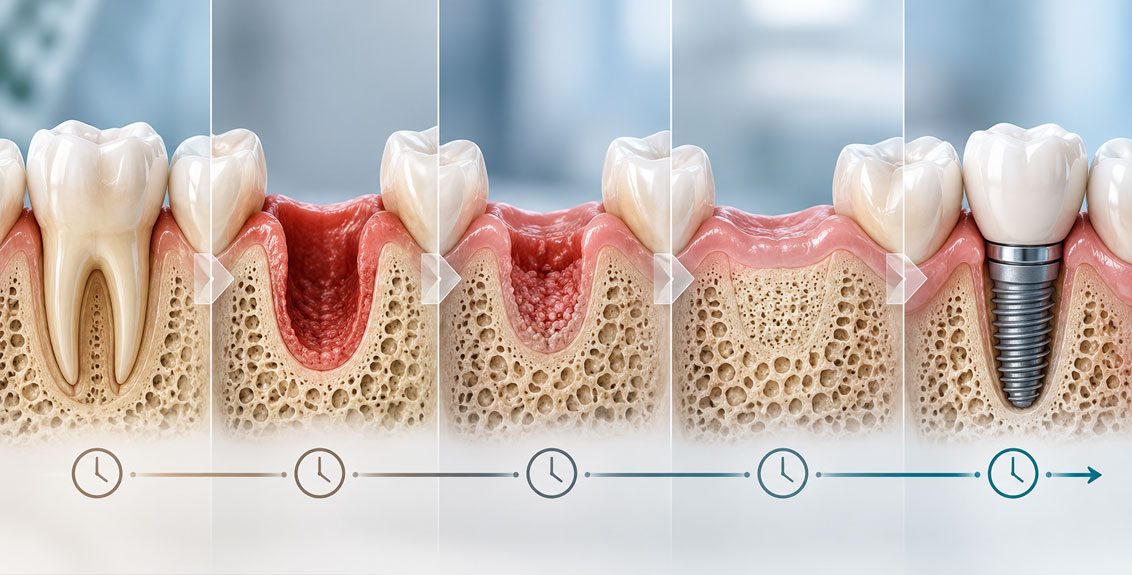
Removing a tooth begins a natural healing process. The empty space left in the jaw, known as the extraction socket, gradually fills with new tissue and bone. At the same time, the ridge of bone that previously supported the tooth begins to change in shape and dimensions.
Research has documented this remodeling process after extraction. An influential experimental animal study by Araújo and Lindhe demonstrated significant dimensional changes in the extraction ridge during the early weeks of healing, particularly involving the outer, or cheek-side, bone wall. [3] The study was conducted in dogs, so its findings should not be interpreted as direct measurements of human healing, although it contributed substantially to research into post-extraction bone remodeling.
These biological changes help explain why timing matters. A clinician must determine whether conditions are suitable for placing an implant immediately or whether allowing some degree of soft-tissue or bone healing is likely to provide a more appropriate treatment site.
Four Different Timing Approaches
Implant placement following extraction is commonly divided into four general timing categories. According to the 2019 European Workshop in Periodontology consensus, these range from immediate placement to placement in a fully healed ridge. [1]
– Immediate placement (Type 1): at the time of extraction or shortly afterward.
– Early placement after soft-tissue healing (Type 2): approximately 4–8 weeks after extraction.
– Placement after partial bone healing (Type 3): approximately 3–4 months after extraction.
– Placement in a healed ridge (Type 4): generally more than 4 months after extraction.
These periods describe clinical approaches rather than deadlines. The appropriate category depends on the characteristics of the individual site. [1]
When Can an Implant Be Placed Immediately?
Immediate placement can shorten the overall treatment process and may reduce the number of separate surgical procedures. However, it requires careful case selection. [1][2]
A favorable extraction site generally needs enough healthy bone to allow the implant to be positioned correctly and held firmly. This initial mechanical grip is known as primary stability. The condition of the socket walls, gum thickness, local infection or inflammation, and available bone can all influence whether immediate placement is appropriate. [1]
Immediate implant placement also does not eliminate the natural remodeling of the bone after extraction. Depending on the anatomy of the site, bone-grafting material may be used around the implant to help manage the space between the implant and socket walls or support the shape of the ridge. [1]
The decision can be particularly important for front teeth, where relatively small changes in the position of the gum or underlying bone can affect the appearance of the final restoration.
Why Waiting Can Sometimes Be the Better Approach
Waiting does not mean that something has gone wrong. In many cases, healing is deliberately incorporated into the treatment plan.
If an extraction leaves damaged socket walls, if acute local infection is present, if the surrounding tissues are unfavorable, or if sufficient initial implant stability cannot be achieved, an early or delayed approach may provide more suitable conditions for implant placement. [1]
Waiting approximately 4–8 weeks, for example, allows soft tissue to heal while treatment still occurs relatively early in the healing process. Waiting approximately 3–4 months permits more bone healing before placement. Longer periods may be appropriate when the extraction site requires greater healing or reconstruction. [1]
The objective is therefore not necessarily to place the implant as quickly as possible. It is to choose a time when the site offers appropriate conditions for predictable treatment.
What Does the Clinician Evaluate?
Several factors are considered together when deciding when an implant should be placed.
Bone availability. There must be sufficient appropriately positioned bone to support the implant. Three-dimensional imaging, such as cone-beam computed tomography (CBCT)—a dental scan that creates a three-dimensional view of the jaws—may help the clinician evaluate the site.
Condition of the extraction socket. Intact socket walls can make immediate treatment more favorable, while damaged or very thin bone may influence the treatment approach.
Gum and soft tissue. The thickness and condition of the gum surrounding the extraction site can affect healing and the final appearance.
Acute infection and inflammation. Acute local infection can make immediate procedures less predictable. Depending on its nature and extent, an early or delayed placement strategy may be considered. [1]
Primary stability. The implant needs sufficient initial stability in an appropriate position. If the available bone cannot provide this, delaying placement may be preferable. [1]
Individual factors—including smoking, periodontal disease and certain medical conditions—may also influence healing and treatment planning.
How Bone Grafting Can Affect the Timeline
Bone grafting does not always require a completely separate procedure.
In some situations, graft material is placed immediately after extraction in a procedure known as alveolar ridge preservation, sometimes also called socket preservation. Its purpose is to reduce dimensional changes in the ridge while the extraction site heals. [1]
In other cases, grafting may be performed at the same time as implant placement or as a separate procedure beforehand. The resulting treatment schedule depends on the amount of bone missing, the type of reconstruction required, and the healing characteristics of the individual site. [1]
This helps explain why two people having apparently similar teeth removed may receive very different implant timelines.
The Calendar Is Only Part of the Decision
The most important point is that implant timing should be determined by the condition of the individual extraction site, rather than simply by counting the number of weeks since the tooth was removed.
Immediate placement can be appropriate in carefully selected situations, while early or delayed placement may provide more favorable conditions in others. Consensus recommendations therefore emphasize assessing the site and the individual patient when choosing the timing of implant placement. [1][2]
For someone considering an implant after extraction, the useful question is therefore not simply “How long must I wait?” A better discussion with the treating clinician is what conditions at the extraction site determine when the implant should be placed.
This article provides general educational information and is not a substitute for individual diagnosis or treatment planning by a qualified dental professional.
References & Sources
[1] Tonetti MS, Jung RE, Avila-Ortiz G, et al. Management of the extraction socket and timing of implant placement: Consensus report and clinical recommendations of group 3 of the XV European Workshop in Periodontology. Journal of Clinical Periodontology. 2019;46(Suppl 21):183–194. DOI: 10.1111/jcpe.13131. Link
[2] Hämmerle CHF, Chen ST, Wilson TG Jr. Consensus statements and recommended clinical procedures regarding the placement of implants in extraction sockets. International Journal of Oral & Maxillofacial Implants. 2004;19(Suppl):26–28. Link
[3] Araújo MG, Lindhe J. Dimensional ridge alterations following tooth extraction: An experimental study in the dog. Journal of Clinical Periodontology. 2005;32(2):212–218. DOI: 10.1111/j.1600-051X.2005.00642.x. Link
Important Keywords
dental implant after tooth extraction, immediate dental implant after extraction, dental implant timing, implant placement after tooth extraction, tooth extraction healing before implant, delayed dental implant, single tooth implant, bone grafting before implant
What do you feel about this post?

Like

Love

Happy

Haha

Sad