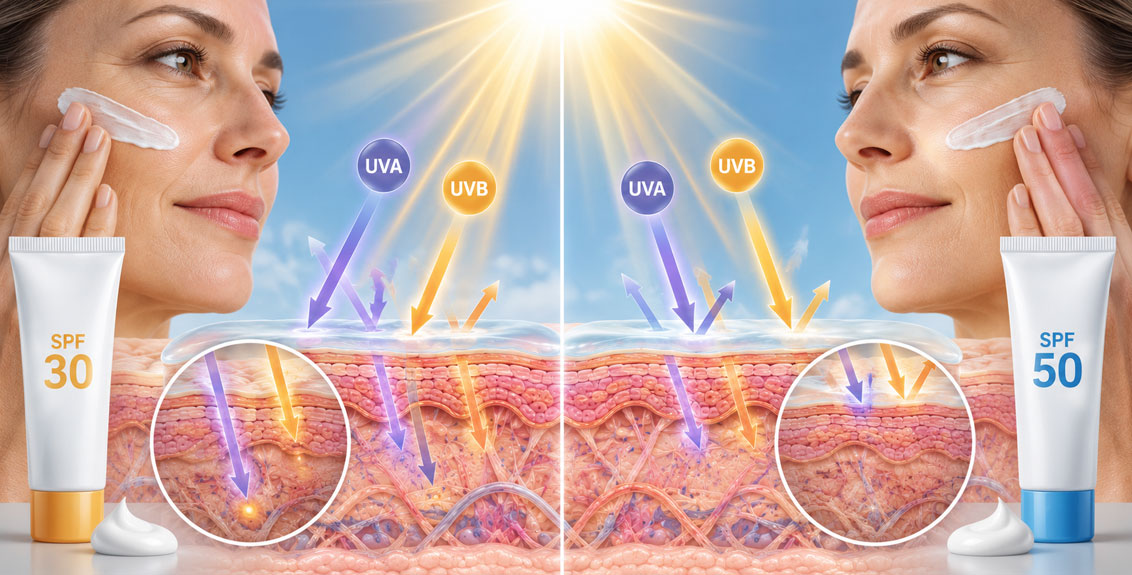
SPF 50 provides more UVB protection than SPF 30, but the difference is smaller than the numbers might suggest. Under standardized testing conditions, both provide high levels of protection when applied correctly. In everyday use, how sunscreen is applied and reapplied can be just as important as choosing between the two.
What SPF Actually Measures
SPF, or sun protection factor, indicates a sunscreen’s level of protection against sunburn. It is determined by comparing the amount of ultraviolet (UV) radiation needed to cause sunburn on sunscreen-protected skin with the amount needed on unprotected skin. [1]
Because sunburn is primarily caused by UVB radiation, SPF mainly reflects protection against UVB. [1] UVA radiation, meanwhile, penetrates more deeply into the skin and contributes to skin aging as well as skin cancer risk. [2][3]
Why SPF 30 and SPF 50 Are Closer Than They Look
SPF is not a simple linear percentage scale. SPF 50 therefore does not provide proportionally as much additional protection over SPF 30 as comparing the numbers 50 and 30 might suggest.
According to Australia’s Therapeutic Goods Administration, when sunscreen is used correctly, SPF 30 filters approximately 97% of UVB radiation, while SPF 50 filters approximately 98%. The agency describes the difference in protection as small. [2]
That extra protection is real, but both numbers represent substantial UVB filtration. Neither provides complete protection.
These figures also describe performance under controlled testing conditions. They should not be interpreted as a guarantee of the protection someone will receive during ordinary daily use. [1][2]
When SPF 50 May Still Be Useful
A small difference can still matter. Someone expecting prolonged or intense sun exposure, for example, may prefer the additional protection offered by SPF 50.
Individual circumstances also differ. People who are particularly sensitive to sunlight or who have medical reasons for minimizing ultraviolet exposure may need individualized recommendations from a healthcare professional.
The important point is that a higher SPF should provide additional protection, not a substitute for proper sunscreen use.
Application Can Change the Protection You Receive
Sunscreen must be applied adequately to provide the protection indicated on its label.
The FDA recommends that an average adult use at least one ounce—approximately enough to fill a shot glass—to cover exposed areas of the body from head to toe, and advises reapplying sunscreen at least every two hours and more frequently when swimming or sweating. [1]
Research and clinical guidance also indicate that people frequently apply less sunscreen than recommended, reducing the protection they actually receive. [3]
Choosing SPF 50 therefore should not be treated as permission to use less sunscreen or skip reapplication.
Nor does SPF 50 simply “last longer” than SPF 30. The FDA specifically explains that SPF relates to the amount of solar exposure, not a fixed number of hours someone can safely remain in the sun. [1]
Don’t Forget Broad-Spectrum Protection
The SPF number alone does not fully describe protection against UVA radiation.
A sunscreen labeled broad spectrum provides protection against both UVA and UVB radiation. [1] This makes the broad-spectrum designation an important consideration alongside the SPF number itself.
The Practical Difference
For someone choosing between SPF 30 and SPF 50, the numbers should be kept in perspective. Correctly applied SPF 30 already provides substantial UVB protection, while SPF 50 provides a modest additional margin. [2]
Whichever is chosen, adequate application, regular reapplication and broad-spectrum protection remain important. Sunscreen should also be combined with other sun-protective measures such as shade, protective clothing, hats and sunglasses. [1]
The practical question, therefore, is not simply “Is 50 better than 30?” It is whether the sunscreen provides appropriate broad-spectrum protection and will be applied correctly and consistently.
This article provides general educational information and does not replace individualized medical advice.
References & Sources
[1] U.S. Food and Drug Administration. Sunscreen: How to Help Protect Your Skin from the Sun. FDA, updated September 2026. Evidence type: Regulatory and consumer health guidance. The current FDA guidance supports the definitions of SPF and broad-spectrum protection, application amount, reapplication guidance, and the distinction between solar exposure and time. U.S. Food and Drug Administration – Link
[2] Therapeutic Goods Administration, Australian Government. How to Choose a Sunscreen. TGA. Evidence type: Government/regulatory guidance. The current guidance states that correctly used SPF 30 filters approximately 97% of UVB radiation and SPF 50 approximately 98%, and characterizes the difference as small. Therapeutic Goods Administration (TGA) – Link
[3] Kuritzky LA, Beecker J. Sunscreens. CMAJ. 2015;187(13):E419. DOI: 10.1503/cmaj.150258. PMID: 26243823. PMCID: PMC4577364. Evidence type: Peer-reviewed clinical practice summary. Link
Important Keywords
SPF 30 vs SPF 50, SPF 30 sunscreen, SPF 50 sunscreen, what SPF means, UVB protection, broad-spectrum sunscreen, sunscreen protection
What do you feel about this post?

Like

Love

Happy

Haha

Sad