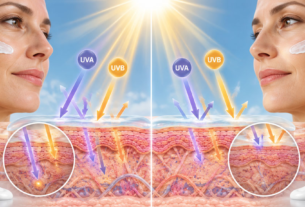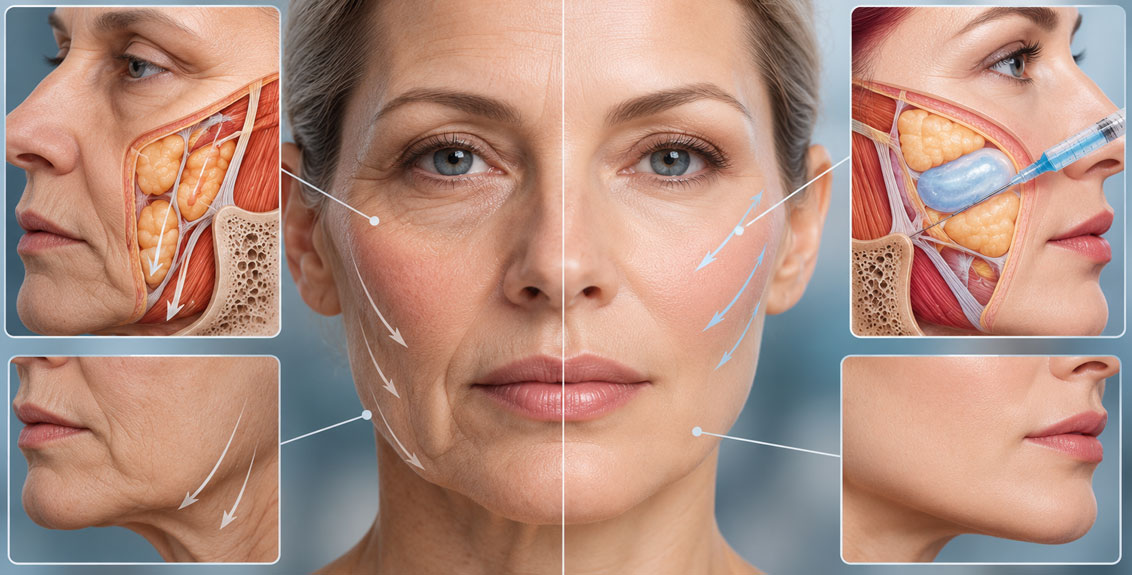
Flatter cheeks, deeper folds around the mouth, and a softer jawline are often described as “volume loss.” Sometimes that is accurate. In other cases, tissues have loosened or shifted downward. These are different anatomical changes. Dermal fillers primarily add volume, contour, or structural support; they do not directly tighten loose skin or reposition significantly descended tissue. Understanding that distinction helps explain why filler may be useful for some age-related changes but limited for others.
Facial Aging Happens in Layers
Facial aging involves much more than wrinkles appearing on the skin. Many visible changes reflect a combination of reduced skin elasticity, changes in facial fat, alterations in deeper supporting tissues, and gradual changes in the underlying facial bones. [1]
These changes do not necessarily occur at the same rate or in the same places.
Facial fat, for example, is not distributed as one continuous layer beneath the skin. Anatomical research has shown that it is organized into distinct fat compartments—separate areas of fatty tissue divided by fibrous boundaries. These compartments can change differently as the face ages, helping explain why one region may appear hollow while another becomes heavier or shifts downward. [2]
The aging face therefore cannot be understood simply as a face that has “lost volume.”
What Facial Volume Loss Means
Facial volume loss refers to a reduction or alteration in the tissues that contribute to facial fullness and shape.
Fat may diminish or redistribute, while changes in the underlying facial skeleton can also affect structural support. [1] In the midface—the region around the cheeks—these changes may produce flattening or hollowing and can alter the smooth transitions that previously existed between different areas of the face.
As contours change, shadows may become more noticeable and existing folds can appear deeper. In such situations, restoring volume in carefully selected areas may improve facial contour.
But volume loss is only one component of facial aging.
What Skin Laxity Means
Skin laxity means looseness or reduced firmness of the skin and its supporting tissues.
As the face ages, changes occur in collagen and elastin—the structural proteins that contribute to skin strength and elasticity—as well as in deeper support structures, facial fat and bone. The combined effect can contribute to tissue descent, less defined contours, and changes such as early jowling. [3]
This is fundamentally different from simply having too little volume.
A useful way to understand the distinction is that volume loss concerns how much structural fullness is present and where it is located, while laxity concerns how firmly tissues are supported and positioned.
In reality, the two frequently occur together.
Why Volume Loss and Laxity Can Look Similar
A deeper fold beside the nose, a flatter cheek or reduced jawline definition can result from volume changes, tissue descent, or a combination of both.
Because different facial layers age differently, two people with apparently similar concerns may have different underlying anatomical changes. Even within the same face, one region may primarily show volume deficiency while another shows greater tissue laxity. [1][2]
This is one reason treatment planning cannot reliably be based only on the location of a visible line, hollow or fold.
The important question is not simply where does the face look older? It is what anatomical change is producing that appearance?
What Dermal Fillers Are Designed to Do
Dermal fillers are injectable materials used to add volume, alter contour or provide structural support in selected areas.
Hyaluronic acid fillers are among the commonly used types. Hyaluronic acid is a substance naturally found in the body that can also be formulated into injectable gels for aesthetic treatment.
When genuine volume deficiency is an important part of the problem, appropriately selected filler treatment may help restore contour. A systematic review examining hyaluronic acid fillers for cheek and midface augmentation found generally high patient satisfaction among the included studies and reported follow-up extending to 24 months. The authors also emphasized the importance of individualized treatment planning. [4]
Those findings, however, concern volume augmentation in appropriately selected patients. They should not be interpreted to mean that filler can correct every change associated with facial aging.
Fillers add material. They do not remove excess skin, directly tighten loose tissue, or reproduce the tissue repositioning achieved through surgery.
When Adding More Volume May Not Solve the Problem
If tissue looseness or descent is the dominant issue, adding volume may create additional fullness without adequately addressing the underlying change in tissue position or firmness.
This distinction becomes especially important when someone is considering repeated filler treatments.
Some approaches to facial rejuvenation may use combinations of treatments because different procedures address different anatomical components of aging. Reviews discussing facial laxity and overfilling emphasize the importance of evaluating the individual layers and structures involved rather than treating all age-related changes simply as missing volume. [3]
There is no universal threshold at which a face has “too much laxity” for filler. Treatment suitability depends on individual anatomy, the area being treated, previous procedures, treatment goals and professional clinical judgment.
Why Overfilling Can Become a Problem
Repeatedly adding filler when volume deficiency is not the principal issue can potentially alter natural facial proportions.
A 2026 narrative clinical review discusses facial overfilled syndrome, describing features that can include excessive fullness, distorted contours and changes that become particularly apparent during facial expression. The authors associate the problem with factors including inappropriate filler volume, incorrect treatment planning and the cumulative effects of repeated procedures. [3]
Importantly, this publication is a narrative clinical review rather than a systematic review, and the authors note that objective quantitative standards for diagnosing or measuring facial overfilling have not yet been established. [3]
That limitation matters. It means the concept should not be treated as though researchers have identified a precise amount of filler that becomes excessive for everyone.
Instead, the broader lesson is that successful treatment depends on understanding facial anatomy and identifying the actual source of a visible change rather than repeatedly adding volume wherever aging becomes noticeable.
Dermal Fillers Also Have Medical Risks
Dermal filler injections are medical procedures and are not risk-free.
Temporary effects can include swelling, bruising, redness, pain and tenderness around the treated area. [5] More serious complications are less common but can occur.
One of the most important is vascular occlusion, which occurs when filler unintentionally enters or obstructs a blood vessel and interferes with blood flow. The U.S. Food and Drug Administration identifies accidental injection into a blood vessel as the most concerning risk associated with dermal fillers. Potential consequences can include tissue injury and, in rare circumstances, serious complications such as vision abnormalities, including blindness, or stroke. [5]
These risks are another reason filler treatment should be performed by an appropriately qualified healthcare professional who understands facial anatomy, filler use and the recognition and management of complications, while practicing within the regulations applicable to their jurisdiction.
Start by Identifying What Has Actually Changed
The visible signs of facial aging do not all have the same cause.
A flatter cheek may reflect volume changes. A softer jawline may involve tissue descent. A deeper facial fold may result from several anatomical changes occurring simultaneously. Often, volume loss and laxity coexist.
Dermal fillers can be useful when adding volume or structural support appropriately addresses part of the underlying problem. Their limitations become important when loose or significantly descended tissues are treated simply by adding more material.
Good aesthetic planning therefore begins not with the question “Where should filler be placed?” but with a more fundamental one: “What has actually changed?”
Normal facial aging is not a defect, and choosing whether to pursue aesthetic treatment is personal. For people who do consider treatment, understanding the difference between volume loss and tissue laxity can help create more realistic expectations and support a better-informed discussion with a qualified healthcare professional.
This article provides general educational information and is not a substitute for individual medical assessment, diagnosis or treatment advice.
References & Sources
[1] Coleman SR, Grover R. The anatomy of the aging face: volume loss and changes in 3-dimensional topography. Aesthetic Surgery Journal. 2006;26(1 Suppl):S4–S9. DOI: 10.1016/j.asj.2005.09.012. Link
[2] Rohrich RJ, Pessa JE. The fat compartments of the face: anatomy and clinical implications for cosmetic surgery. Plastic and Reconstructive Surgery. 2007;119(7):2219–2227. DOI: 10.1097/01.prs.0000265403.66886.54. Link
[3] Zhou C, Che Q, Zhao R, Wang H, Wa Q. Facial Overfilled Syndrome: A Narrative Clinical Review. Clinical, Cosmetic and Investigational Dermatology. 2026;19:600459. DOI: 10.2147/CCID.S600459. Link
[4] Trinh LN, Gupta A. Hyaluronic Acid Fillers for Midface Augmentation: A Systematic Review. Facial Plastic Surgery. 2021;37(5):576–584. DOI: 10.1055/s-0041-1724122. PMID: 33634456. Link
[5] U.S. Food and Drug Administration. Dermal Fillers (Soft Tissue Fillers). FDA guidance on dermal filler uses, risks and safety considerations. Link
Important Keywords
facial volume loss vs skin laxity, dermal fillers for facial aging, facial volume loss, loose facial skin, dermal filler limitations, filler for sagging skin, cheek filler and aging, age-related facial changes, facial overfilling, vascular occlusion
What do you feel about this post?

Like

Love

Happy

Haha

Sad