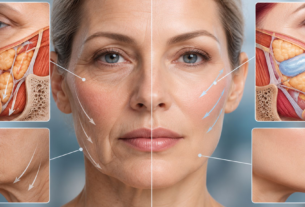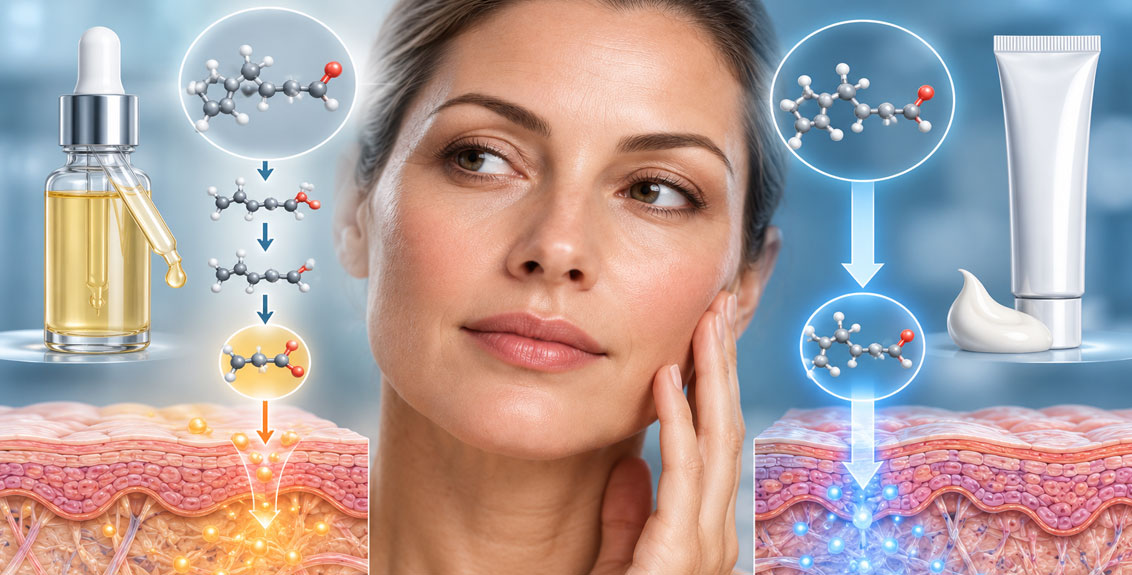
Same Family, Different Forms
Retinoid is the broad term for a family of vitamin A-related compounds used in skincare and medicine. Retinol is an over-the-counter member of that family commonly found in cosmetic skincare products. Tretinoin, by contrast, is retinoic acid itself and is available as a prescription medication in many countries.
The terms retinoid, retinol and tretinoin therefore do not mean the same thing—and not every vitamin A derivative found in skincare behaves exactly like retinol.
Why Conversion Matters
Retinoic acid is the biologically active form that interacts with specialized receptors in skin cells and influences cellular processes. Retinol is a precursor: it must undergo conversion within the skin before reaching retinoic acid. [5] Tretinoin is already retinoic acid, so it does not require those same conversion steps.
This helps explain why tretinoin generally has a more direct biological action. But greater directness does not automatically make it the best starting choice for everyone, particularly because tolerability also matters.
Tretinoin Has the Stronger Evidence for Photoaging
Tretinoin is the most extensively studied topical retinoid for photoaging, the changes in skin associated with cumulative sun exposure. [3]
A systematic review of seven randomized controlled trials found that topical tretinoin improved several features of photoaged skin, including fine and coarse wrinkling, mottled pigmentation and lentigines, commonly called age or sun spots. Some improvements were reported beginning within about one month, while included studies ranged in duration up to 24 months. [1]
The review also identified limitations. The studies used different formulations and outcome measures, and the authors noted a need for additional contemporary research. [1]
Retinol Has Evidence Too — but Less of It
Retinol also has clinical evidence behind it, although the evidence base is smaller and should not be treated as equivalent to that for prescription tretinoin.
In a randomized, double-blind study, a 0.4% retinol lotion used for 24 weeks improved fine wrinkling in naturally aged skin compared with the same formulation without retinol. [2] However, the study was relatively small, evaluated skin on the arms of older adults, and did not directly compare retinol with tretinoin.
A 2024 systematic review examining tretinoin against other topical treatments found that many comparative studies were of poor quality or had potential bias. The authors concluded that evidence was insufficient to establish another topical treatment as a first-line replacement for tretinoin for photoaging. [4]
The practical conclusion is not that retinol is ineffective. Rather, retinol has evidence of benefit, while equivalence to tretinoin has not been established.
Stronger Does Not Automatically Mean Better
Tolerability is an important part of the decision.
A clinical review of topical retinoids noted that irritation—including burning, scaling and inflammation—can limit acceptance of tretinoin, while retinol is generally less irritating. [3] The 2024 systematic review similarly found that most treatments compared with tretinoin were better tolerated. [4]
This matters because skincare benefits generally depend on continued use. A treatment that repeatedly produces unacceptable irritation may be difficult to use consistently.
Irritation Is a Side Effect, Not the Goal
Dryness, peeling, redness, burning, stinging and itching can occur with tretinoin. The prescribing information for RENOVA 0.02% reports that almost all participants in its controlled clinical studies experienced at least one local reaction. [6]
These effects should not be interpreted as evidence that greater irritation produces better results. The same prescribing information states that applying larger amounts has not been shown to produce faster or better results and may instead cause marked redness, peeling or discomfort. [6]
Persistent or substantial irritation deserves professional guidance rather than simply increasing or continuing treatment without review.
When Retinol May Be a Reasonable Starting Point
For someone primarily interested in skin appearance or signs of photoaging who is concerned about tolerability, an over-the-counter retinol product can be a reasonable option to consider. Clinical research demonstrates biological activity and potential improvement in aged skin, although individual products can differ considerably in formulation, concentration and stability. [2][5]
Someone seeking the option with the strongest clinical evidence for photoaging may instead wish to discuss prescription tretinoin with a qualified healthcare professional.
Neither choice is automatically appropriate for everyone.
Safety and the Practical Takeaway
People who are pregnant or planning pregnancy should discuss retinoid-containing products with a healthcare professional. Current prescribing information for RENOVA specifically advises against tretinoin use during pregnancy or when attempting to become pregnant. [6]
Professional guidance is also appropriate for persistent irritation, existing skin conditions, prescription treatment, or when retinoids are being considered for acne or another medical concern.
For a beginner, the useful distinction is straightforward: retinol offers a less direct, generally better-tolerated route with some clinical evidence, while tretinoin has a stronger evidence base for photoaging but greater potential for irritation. Stronger does not necessarily mean more appropriate. The better starting choice depends on the reason for treatment, individual skin tolerance and whether professional supervision is needed.
This article provides general educational information and is not a substitute for individual medical advice.
References & Sources
[1] Sitohang IBS, Makes WI, Sandora N, Suryanegara J. Topical tretinoin for treating photoaging: a systematic review of randomized controlled trials. International Journal of Women’s Dermatology. 2022;8(1):e003. DOI: 10.1097/JW9.0000000000000003. PMID: 35620028. Evidence type: Systematic review of randomized controlled trials.
Link
[2] Kafi R, Kwak HSR, Schumacher WE, Cho S, Hanft VN, Hamilton TA, et al. Improvement of naturally aged skin with vitamin A (retinol). Archives of Dermatology. 2007;143(5):606–612. DOI: 10.1001/archderm.143.5.606. PMID: 17515510. Evidence type: Randomized, double-blind, vehicle-controlled trial. Link
[3] Mukherjee S, Date A, Patravale V, Korting HC, Roeder A, Weindl G. Retinoids in the treatment of skin aging: an overview of clinical efficacy and safety. Clinical Interventions in Aging. 2006;1(4):327–348. DOI: 10.2147/ciia.2006.1.4.327. Evidence type: Clinical review. Link
[4] Siddiqui Z, Zufall A, Nash M, Rao D, Hirani R, Russo M. Comparing Tretinoin to Other Topical Therapies in the Treatment of Skin Photoaging: A Systematic Review. American Journal of Clinical Dermatology. 2024;25(6):873–890. DOI: 10.1007/s40257-024-00893-w. PMID: 39348007. Evidence type: Systematic review. DOI – Link
[5] Shao Y, He T, Fisher GJ, Voorhees JJ, Quan T. Molecular basis of retinol anti-ageing properties in naturally aged human skin in vivo. International Journal of Cosmetic Science. 2017;39(1):56–65. DOI: 10.1111/ics.12348. PMID: 27261203. Evidence type: Human mechanistic study. Link
[6] U.S. National Library of Medicine, DailyMed. RENOVA (tretinoin cream) 0.02% — Prescribing Information. Evidence type: Official drug labeling. The current label addresses local adverse reactions, excessive application and pregnancy precautions. Link
Important Keywords
retinol vs prescription retinoid, retinol vs tretinoin, retinol for beginners, prescription retinoid, topical retinoids, retinol skin benefits, tretinoin for photoaging, retinol irritation, retinoic acid, photoaging
What do you feel about this post?

Like

Love

Happy

Haha

Sad